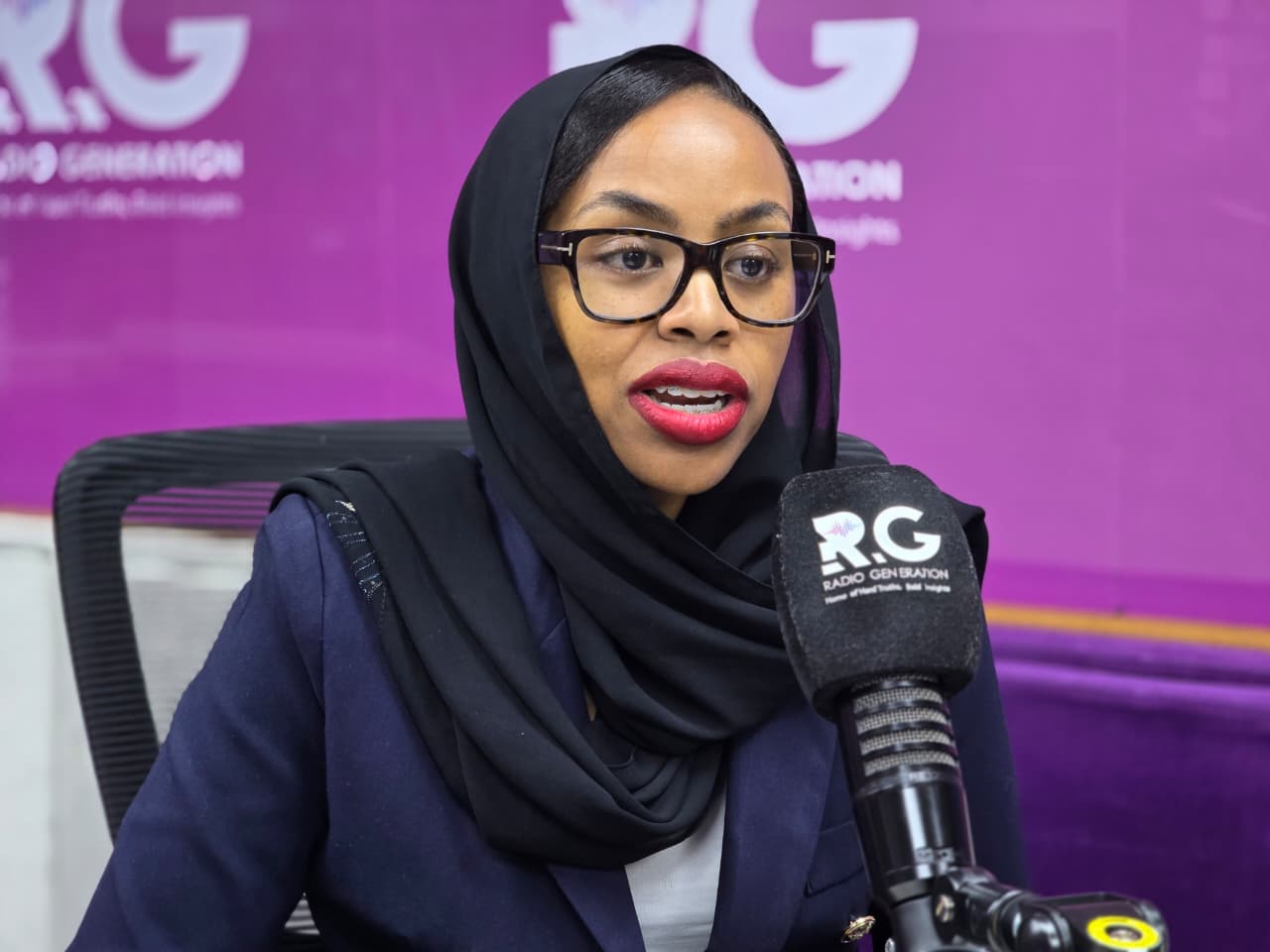
Women representatives in Kenya continue to face unequal funding, societal pressure, and political risks that limit how effectively they serve, People’s Liberation Party Secretary General Asha Bashir has said.
Speaking during an interview on Radio Generation on Tuesday, Asha Bashir said women leaders operate under conditions shaped by patriarchy, limited financial resources, and exposure to political violence, all of which affect their performance in office.
She pointed out that allocations under the County-Based Fund (CBF) and Gender Affirmative Fund (GAF) given to women representatives are far lower than those given to Members of Parliament, yet women reps are expected to serve entire counties.
“If you’re given, let’s say, seven to 10 million, and your counterpart is given 100 million, and you’re expected to run the county… the woman rep seat should be used as a mentorship platform,” she said.
Bashir said the women representative position should be viewed as a training ground that helps women gain experience before vying for other elective offices, while also contributing to efforts aimed at meeting the two-thirds gender rule in leadership.
Her remarks come at a time when discussions around gender representation in public offices are ongoing, with a bill before the Senate seeking to strengthen compliance with constitutional requirements on equality.
The County Governments (Amendment) Bill, 2026, sponsored by Marsabit Senator Mohamed Chute, proposes changes to Section 35 of the County Governments Act to ensure that no more than two-thirds of county executive committee members are of the same gender.
The bill also calls for inclusivity in county cabinets by ensuring representation of different cultural groups and inclusion of persons with disabilities. It further introduces tighter vetting procedures, timelines for corrective action, and enforcement measures to compel governors to comply.
Bashir also raised concerns about how women representatives are perceived by the public, saying many people assume their offices are not effective due to limited visible results.
She noted that some members of the public dismiss the role, suggesting that women representatives do not deliver value, a perception she believes does not reflect the realities of their responsibilities.
To address accountability and public trust, she proposed audits across all political offices to evaluate how public funds are used and what impact they produce.
“The audit is important, not only for the women representative seat, but across all positions,” she said.
Bashir further highlighted patriarchy as a major barrier that discourages women from entering or advancing in politics, saying societal expectations often limit their participation or subject them to opposition.
She gave examples from other countries, including Uganda, where she said a female leader faced resistance even from within her family during her political rise, illustrating the challenges women encounter.
Financial limitations were also cited as a key constraint, with Bashir noting that Members of Parliament receive higher allocations for constituency projects, while women representatives must manage smaller budgets across larger populations.
She also warned that political violence remains a serious concern, saying female candidates and their families are sometimes targeted during election campaigns.
“It takes a strong force for you to be a woman in politics, but the Constitution gives a platform, and that platform should be used,” she said.
Bashir maintained that the issue is not about capability but about fairness, access to resources, and societal attitudes that shape how women participate in leadership.
She referred to Rwanda as an example where women hold a high level of representation in leadership, saying this demonstrates the impact of deliberate efforts to support gender inclusion.
She concluded that women representatives should be supported through mentorship and capacity building to help them transition into competitive elective positions, while also strengthening gender balance in political leadership.